 CALL US:
  777 S Central Expressway, Suite 101 Richardson, TX 75080
NFPA 1225, Standard for Emergency Services Communications, defines an in-building emergency responder communications enhancement system as “a combination of components, radio frequency emitting devices, antennas, cables, power supplies, control circuitry, and programming installed at a specific location to improve wireless communication at that location.”
RELATED: Read about when an ERCES is required
Often abbreviated as ERCES, these systems can also be referred to as bidirectional antenna systems or bidirectional amplifiers, either of which can be abbreviated as BDAs. Sometimes they are just called signal boosters.
Why Do We Need Communications Enhancement Systems?
Emergency responders, whether firefighters, police, or emergency medical personnel, need to be able to have clear communication with their team members in order to do their jobs of keeping the public safe.
One of the most common ways emergency responders communicate is through portable radios. Radios work by transmitting and receiving electromagnetic waves of a certain frequency. Radio waves are weakened when they pass through most objects but are particularly susceptible to modern building materials and features meant to increase energy efficiency. Due to the weakening of radio signals as they pass through objects, the radios of emergency responders might not work in certain buildings.
Therefore, it’s essential that there be technology in place to be able to amplify the signal that emergency responders use so they can communicate effectively. This is where emergency responder communications enhancement systems come in.
What Is an Emergency Responder Communications Enhancement System?
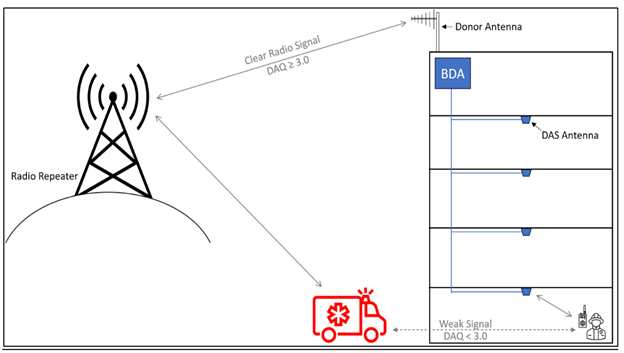
Typically, portable radios work by receiving and transmitting a radio frequency signal to a network of large stationary radio repeaters. When the signal can’t get to the portable radio due to interference, an emergency responder communications enhancement system needs to be installed to amplify and repeat the signal in the building to be able to make sure the signal reaches the intended recipient.
The components of an emergency responder communications enhancement system include:
Donor antenna: This typically sits on the rooftop of the building and is the bridge between the radio tower network and the in-building communications enhancement system.
Bidirectional amplifier: This is the component of the system that does the actual amplification of the radio frequency signal. It is an active radio frequency emitting device.
Distributed antenna system: Often abbreviated as DAS, this is a system of antennas that is specifically designed to radiate radio frequency energy into a specific and limited building area, usually from a ceiling- or wall-mounted antenna. These antennas are connected to one another and to the bidirectional amplifier by coaxial cable that carries radio frequency energy in both directions.
Battery backup: This is typically provided to supply 12 hours of battery backup power in the event of a primary power failure. Other backup power sources are permitted as outlined in NFPA 1225.
Requirements for in-building emergency responder communications enhancement systems can be found in Section 11.10 of the 2024 edition of NFPA 1, Fire Code. NFPA 1 requires that buildings be evaluated to ensure that the building construction will not interfere with radio communications, and if it does, systems are required to be installed to increase the radio signal to acceptable levels.
In the 2024 edition of NFPA 101®, Life Safety Code®, requirements for emergency responder communications enhancement systems are found in Section 9.15. New buildings are required to comply with NFPA 1225, while for existing buildings the minimum required signal strength is determined by the authority having jurisdiction (AHJ).
In the 2022 edition of NFPA 1225, Chapter 18 specifically addresses building emergency responder communications enhancement systems, but keep in mind that other chapters of NFPA 1225 apply to this technology where specifically referenced. It is important to note that prior to the 2022 edition of NFPA 1225, requirements for this technology were found in NFPA 1221, Standard for the Installation, Maintenance, and Use of Emergency Services Communications Systems.
If you want to explore the requirements further, you can view all of these codes and standards digitally through NFPA LiNK®. Let me know about your experience with in-building emergency responder communications enhancement systems in the comments below.